Jul 7, 2026 | Featured Story
Blast protection systems are a critical consideration for industrial facilities operating in environments where overpressure events and explosion risks must be managed with precision. In these settings, pressure does not remain confined to a single point. It can move through structural pathways, ventilation systems, service openings, connected rooms, and access routes. This makes protection a facility-wide concern rather than a product-by-product decision.
Large-scale incidents, such as the Buncefield explosion in the UK, show how industrial events can escalate beyond the initial source and affect surrounding infrastructure. The lesson for modern facilities is not that every risk can be eliminated. It is that pressure behaviour must be anticipated across the facility so that protective measures can be placed where they are most effective.
For defence contractors, government agencies, critical infrastructure developers, industrial facility owners, oil and gas operators, energy companies, engineering consultants, architects, safety shelter specialists, M&E contractors, and procurement teams, this distinction matters. The performance of blast protection systems depends on how each protective component interacts with the surrounding structure, airflow design, access strategy, and the site’s risk profile.
FUCARE addresses this need through an engineering-led approach that integrates reinforced barriers, HVAC pressure-control components, explosion-venting solutions, and protected openings. As a safety company headquartered in Singapore, FUCARE develops and manufactures safety shelter products, with a focus on special metal doors and windows, HVAC valves, and dampers for blast and ballistic protection.
This practical guide explains how blast protection systems are used in industrial facilities, how core components contribute to pressure management, and how project teams can approach selection and specification with greater technical clarity.
The fundamental goal of blast protection systems is to manage the interaction between an explosion’s overpressure wave and the built environment. This involves creating controlled points of resistance, regulation, and release across a facility. The systems work by implementing three primary functions: containment, isolation, and pressure relief.
In Singapore, where industrial facilities, utilities, and high-value infrastructure often operate in dense, carefully planned environments, blast protection systems support both industrial safety planning and operational resilience. They are crucial in mitigating secondary damage and reducing the chance that a localised incident affects multiple connected spaces.
Blast protection systems are essential because industrial facilities often contain interconnected zones where pressure can travel quickly if left unmanaged. Unlike conventional fire or security measures, blast effects are dynamic and can affect the entire pressure envelope almost simultaneously.
A plant room, process area, control room, storage space, service corridor, or ventilation network may all become part of the pressure pathway during an overpressure event. Without proper control, force can move beyond the initial source and affect adjacent rooms, mechanical systems, access routes, and critical operational areas.
This is especially important in high-risk environments where one localised event may disrupt wider facility operations. By accounting for how pressure moves through physical and mechanical pathways, blast protection systems help reduce secondary damage, support safer zoning, and preserve the function of protected areas during extreme events.
A single component, no matter how strong, cannot fully manage an overpressure event. A reinforced access point may resist pressure at one boundary, but force may still travel through ducts, service penetrations, grilles, or unprotected openings. Similarly, a venting solution may relieve pressure in one enclosure, but surrounding structural and mechanical interfaces must still perform as intended.
This is why blast protection systems should be designed as coordinated configurations. Each element serves a specific, harmonised purpose within the pressure management strategy:
The coordinated approach also establishes clearer specification logic. Instead of asking whether one product is “strong enough,” engineers can assess the entire pressure sequence: how pressure is expected to build, move, and dissipate. This holistic view helps project teams identify the exact role of each component, reducing performance gaps between structural, architectural, and mechanical systems.
For high-security projects, blast protection systems should be reviewed as part of the facility’s protective architecture, where performance is based on pressure ratings, sealing integrity, anchoring methodology, response behaviour, and seamless integration with surrounding construction.
Blast protection systems support safety by managing how pressure interacts with the building and its internal zones. During an explosion or sudden pressure rise, uncontrolled force can damage walls, doors, windows, equipment, and ventilation systems. It can also create debris and compromise routes needed for emergency access or shutdown procedures.
A well-planned design recognises that protection is based on risk reduction rather than absolute prevention. The aim is not just to absorb the pressure, but to contain it where appropriate, redirect it where necessary, and release it where this can be done safely, thereby preserving critical spaces and human life.
From a structural control perspective, blast protection systems help distribute loads more predictably. Barriers maintain separation between zones. Ventilation devices reduce pressure transfer through ducts. Relief systems reduce excessive internal loads. Protected openings maintain operational use while supporting the facility’s safety envelope.
This structured response can also improve post-incident manageability. When damage is more contained, inspection, isolation, emergency response, and recovery planning may become more practical. For industrial facility owners, blast protection systems should therefore be viewed as a key part of long-term resilience and business continuity planning.
The effectiveness of any blast protection strategy relies on the coordinated function of its core components, each playing a specific role in pressure management and system integrity.
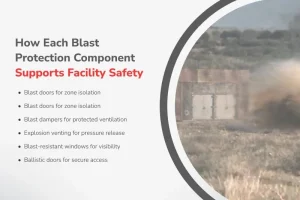
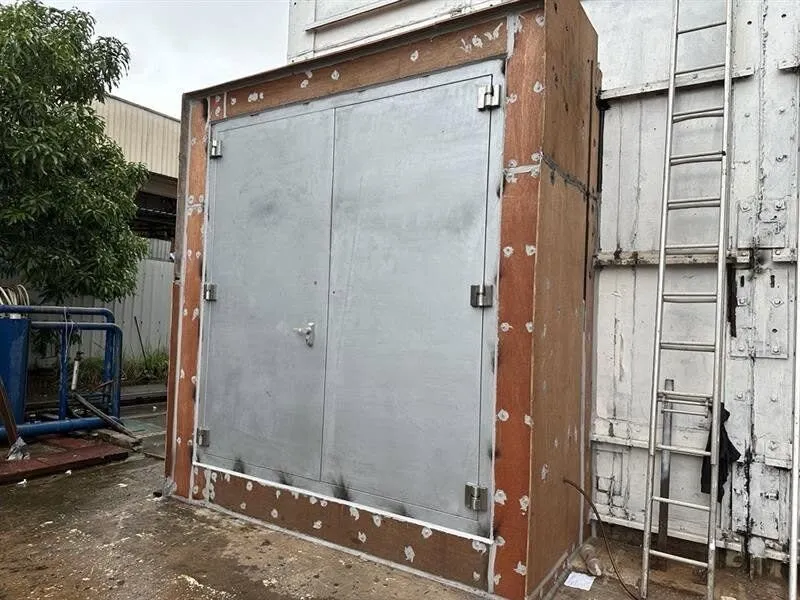
Door performance depends on more than the door leaf. The frame, anchors, hinges, seals, locking mechanism, and surrounding wall construction must all work together. If one interface is weak, the protective boundary may not perform as expected under load.
Reinforced doors separate sections of a facility during an overpressure event. Their role is to help contain force within a defined zone and reduce pressure transfer into adjacent spaces. This is especially important for safety shelters, control rooms, plant areas, hazardous process zones, and protected service spaces.
Material strength and pressure resistance are also central. Reinforced metal construction can help maintain stability during high-force events, while sealing performance helps reduce unwanted leakage through the opening. FUCARE’s approach to protective doors reflects the need for structural resistance, functional performance, and reliable integration with the wider system.
Strategic placement matters as much as product strength. Doors should be positioned at high-risk transitions and zone boundaries where pressure isolation is required. When placed correctly, they become a key part of blast protection systems rather than isolated pieces of hardware.
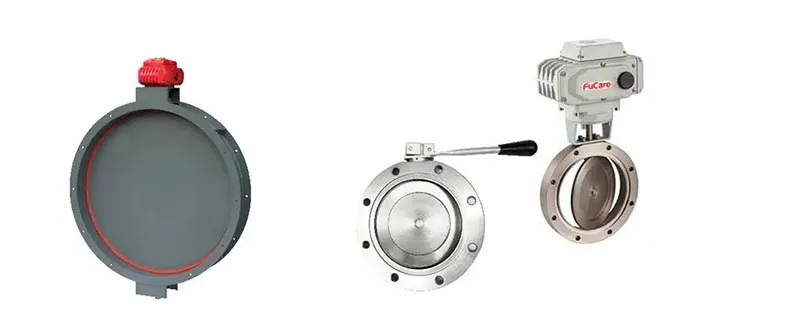
Ventilation systems are necessary for normal operations, providing controlled airflow, thermal management, and safe working conditions. However, ducts, air intakes, exhaust points, and mechanical penetrations can also serve as pressure-transmission routes during an explosion, allowing force to propagate into spaces that would otherwise be structurally protected.
Together, these components help prevent air systems from becoming uncontrolled pathways for blast effects. For M&E contractors and engineering consultants, coordination is essential. The components of blast protection systems must be integrated with duct layouts, airflow requirements, access panels, maintenance schedules, and controls. Effective protection starts when mechanical and safety requirements are planned together, ensuring that the necessary protection does not compromise the facility’s required daily air exchange or thermal control.
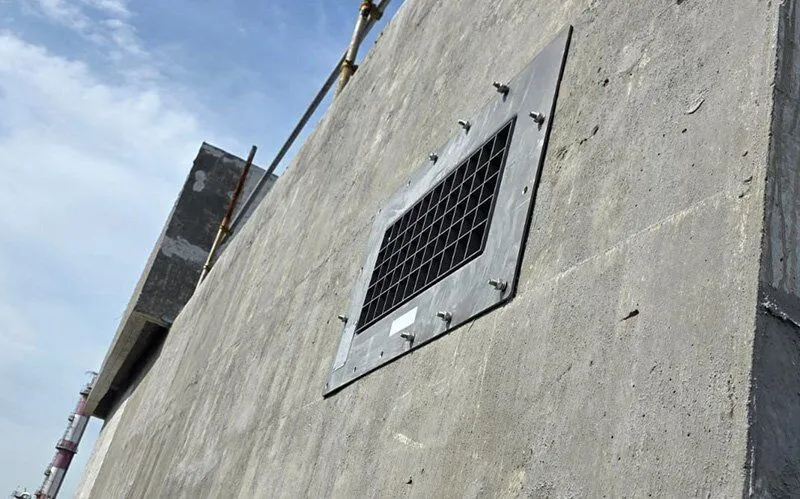
Explosion venting systems provide a controlled method for releasing pressure before it reaches levels that could cause more severe structural damage. Instead of allowing pressure to build unpredictably inside an enclosed space, venting solutions are designed to activate at defined thresholds and discharge force along a planned path.
This is useful in rooms, enclosures, and process areas where pressure relief is necessary to reduce load on walls, ceilings, equipment, or access points. By relieving excess pressure, venting can help reduce structural stress and support a more predictable facility response.
Venting must still be designed with extreme care. The discharge direction, surrounding occupancy, nearby equipment, external space, and maintenance access all affect whether the solution is appropriate. A release path should not create new hazards for personnel or critical assets.
Within blast protection systems, venting works alongside containment barriers and ventilation controls, providing a critical layer of pressure-relief design within the overall configuration.
Some protected zones require visibility, monitoring, and controlled access. A fully opaque or sealed boundary may not suit control rooms, observation areas, security points, or operational interfaces. A blast window provides visibility into a protected area while offering resistance to pressure and impact.
Protected glazing should be assessed as a complete assembly. The frame, anchors, seals, glazing composition, and surrounding wall construction all influence performance. A strong glass panel alone is insufficient if the opening system cannot withstand the same design conditions and transfer the load to the frame. The glass itself is typically multi-layered, laminated, or incorporated with specific materials to maintain integrity even after impact, preventing catastrophic shard generation
A ballistic door may be required where facilities face both pressure-related and projectile-related threats. This is relevant to defence, high-security infrastructure, critical infrastructure, and sensitive industrial environments, where access points must respond to multiple risk types simultaneously.
These components show why blast protection systems must balance protection with usability. Industrial facilities still need to function every day. The aim is to protect critical points without creating unnecessary restrictions for operations, monitoring, maintenance, or emergency access.
Effective specification is not about buying the strongest product; it is about defining the required performance in the context of the entire facility’s risk profile and regulatory environment
Assessing requirements begins with understanding how pressure may move through the facility. Project teams should identify high-risk zones, likely pressure sources, connected rooms, ventilation routes, access openings, service penetrations, and areas that must remain protected during an incident. For Singapore-based high-risk sites, this assessment should also align with SCDF fire safety guidelines, emergency planning requirements, and project-specific authority submissions.
A practical risk map helps clarify where blast protection systems are needed. High-risk areas may include process zones, fuel or chemical storage areas, plant rooms, control rooms, security rooms, utility spaces, and safety shelter areas. Once these zones are defined, engineers can study how pressure could travel through walls, ducts, corridors, doors, and other openings.
The next step is to match each component to its functional role. Doors support isolation. Dampers and valves control airflow pathways. Vents release pressure. Windows preserve visibility. Ballistic-rated components address combined threat profiles. This role-based approach helps the blast protection system operate as a cohesive explosion risk management strategy.
The ultimate objective of this entire assessment is to establish the Design Basis Threat (DBT). The DBT is the most critical step in specification, as it defines the quantifiable, maximum anticipated pressure event that the system must resist. It is established by quantifying the potential event based on factors like the event source (internal or external), TNT equivalent/charge mass, and stand-off distance. This engineering definition is critical as it sets the exact required performance criteria for all protective components, including the necessary peak pressure and impulse duration.
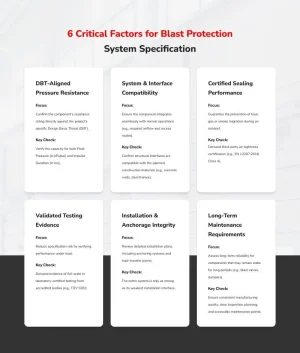
Engineers and contractors must look beyond simple marketing data and confirm the technical specifications through certified testing and documentation. They should consider compatibility, pressure resistance, sealing performance, activation thresholds, airflow impact, installation interfaces, tested performance, and maintenance requirements. The selected components must work under normal operating conditions and remain ready for extreme events.
Compatibility is especially important. A protective component may perform well on its own, but the full system can still be weakened by poor interfaces. Frames, duct transitions, wall openings, anchors, controls, access panels, and inspection points all affect final performance.
Certified performance can support a more confident specification. Project teams should always confirm the specific standards, pressure ratings, and test criteria required for each project.
System configuration determines how effectively pressure is managed across the facility. The same products can produce different results depending on where they are placed, how they are connected, and how they interact with the building structure and mechanical systems.
Coordinated placement is central. Doors should sit at zone boundaries where isolation is needed. Dampers should be located where ventilation pathways require control. Vents should be positioned where pressure can be released without causing unacceptable secondary hazards. Protected windows and access points should support operations without weakening the safety envelope.
Progressive pressure management is also important. Instead of relying on one barrier to resist the full impact of an event, blast protection systems can be configured so that one component contains, another regulates, and another releases. This staged response can reduce sudden load accumulation and support a more controlled outcome.
Early coordination helps the high-stakes requirements of the industrial facility. Protective requirements may affect wall build-ups, room layouts, door swings, duct routes, façade planning, maintenance access, and construction sequencing. When these factors are considered from the start, the final design is more practical, buildable, and aligned with project requirements.
The right combination depends on facility layout, risk profile, pressure pathways, ventilation design, operational access, and protected zones. A site with extensive ductwork may need greater focus on protected ventilation, while a facility with several high-risk compartments may require stronger emphasis on reinforced barriers and controlled access points. A comprehensive, third-party risk assessment based on the specific DBT should guide the final configuration.
Project teams should review pressure resistance, sealing performance, activation thresholds, airflow requirements, wall and duct interfaces, material construction, fire or ballistic requirements where relevant, and third-party testing. Specifications should also cover installation details, inspection access, maintenance expectations, and compatibility with surrounding systems.
FUCARE develops and manufactures engineered protective products for safety shelters and high-security environments. Its range includes reinforced doors and windows, HVAC valves, and dampers designed for blast and ballistic threats. This integrated product portfolio supports a coordinated route from specification to system integration, particularly on projects where several protective components must interface and work together seamlessly under extreme conditions.
Retrofitting may be possible, but it requires careful review of existing structures, openings, duct routes, access points, and space constraints. Existing buildings may not have been designed for new protective loads or interfaces, so engineering assessment is essential before installation.
Well-designed blast protection systems should support daily operations while remaining ready for emergencies. Doors must remain usable where access is required. Ventilation controls must allow normal airflow. Windows must support visibility where needed. The aim is to integrate protection into the facility’s function, not to make routine work more difficult or compromise operational efficiency. Any disruption usually points to a flaw in the system’s initial design or integration plan.
Blast protection systems are a fundamental part of risk management in industrial facilities where overpressure events must be controlled with precision. By integrating protective barriers, HVAC pressure-control components, venting solutions, and reinforced openings, facilities can better manage how pressure is contained, redirected, or released across connected areas. For high-risk environments, this integrated approach supports safer operations, stronger structural control, and more practical long-term resilience, ultimately protecting personnel and ensuring business continuity.
Speak with FUCARE to plan blast protection systems that align with your facility’s risk profile, operational requirements, and project specifications.